

The content of much of this course has honestly been a hobby of mine to study for much of the past 12 years. My interest in history and political theory really coincided. They are still my favorite subjects of study, and are in my view inseperately intertwined subjects. You might be wondering what happened 12 years ago that thrust me into a journey of reading 3 to 4 history or philosophy books a month? I grew up Pentecostal, lost my faith during my first attempt at college, joined the military, and explored all sorts of things. My political leanings were “liberal,” to say the least. To make a long story short, after some confusion about the preponderance of denominations of Christianity, I set about studying Early Church History. You could say that was both the beginning of my personal obsession with History, and a religious awakening for me. It was through that study of history that I discovered Orthodox Christianity. My entire worldview was shaken. Suddenly I was reading Thomas Carlyle, Thomas Hobbes, and Thomas Hutchinson’s Strictures Upon the Declaration of Independence. I studied Byzantine History, Russian Imperial History, the history of the World Revolutions, and I questioned the very foundations of what I grew up believing, and my found my previous Classical Liberal and Progressive views to be at odds with my newly found faith, and the narrative to degenerative departure away from the truth as I was beginning to perceive it. I have to say that this course has been a very pleasant review, and an enjoyable opportunity to engage the content from what I would describe as not the same political slant from which I generally approach it. But I also have to say that there was nothing that really challenged my views, and I walk away more solidified in my conclusions. We live in a current geopolitical World that seems to be on the cusp of another global conflict between the great powers. Many of these battles are currently being fought by various proxies, but could erupt into a full-scale conflict at any moment. The conflict between Russia and Ukraine, arguably a proxy battle between the Western powers and Russia, has been the deadliest conflict since WW2. The United States recently had a brief skirmish with Iran before it was forced into a ceasefire. Domestically, both in the United States and Western Europe, there is a constant state of increasing polarization and political chaos. How long before politics no longer serves as a proxy for violence domestically? What effect does demographic disruption and displacement have in Europe and America? I believe that much of what is happening today, as well as the horrors experienced in the 20th century, is a result of the adoption of Liberal Democracy, which is intolerant of all competing ideologies, including the one it replaced, the ancient Christian regimes.
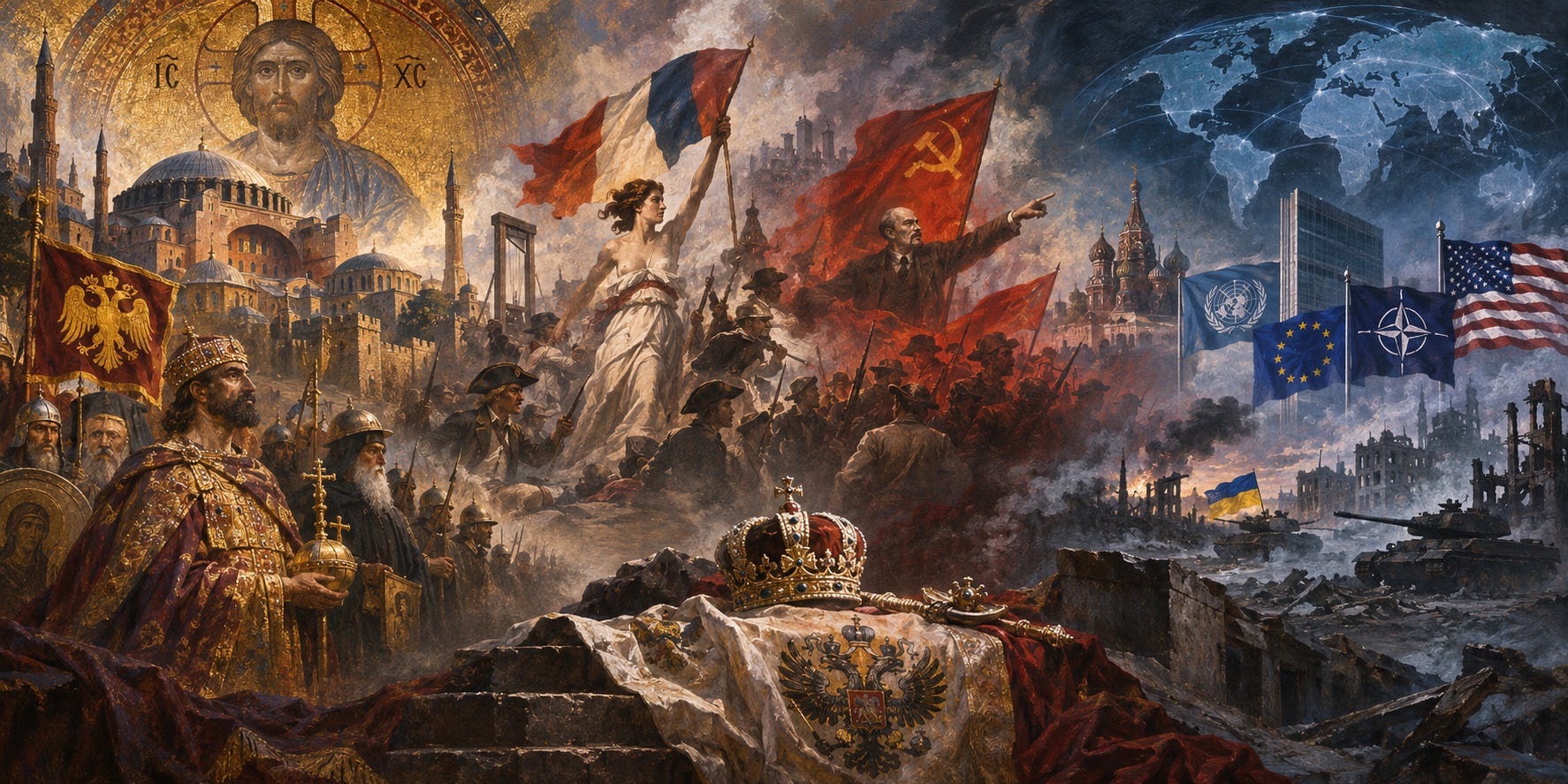
There is a case to be made that all of the trouble really started with the Great Schism, and perhaps the Reformation, but most good right-wing reactionaries such as myself tend to focus on the Enlightenment as the origin of the current regime. That is the Liberal Democratic order (LDO), which is primarily composed of the United States, the United Nations, the European Union, and NATO. There are, of course, plenty of other bodies that are a part of the LDO. It is beyond the scope of this reflection to explain the Enlightenment philosophies in detail. Revolutions were waged on behalf of these ideals, which promised people “self-rule.” Ideas like the State serves at the will of the people, and its primary responsibility is thus to protect the inherent rights of man. Each of these revolutions promised more freedom, but in each instance led to a more intrusive mega state.
To simply say “more intrusive” of the Bolshevik revolution in Russia would be a gross overstatement. In pursuit of that godless utopia, millions were murdered. But in a sense it finished the job the LDO started. World War 1, despite beginning on a trivial pretext, would essentially bring the regimes of Christian Kings to an end. They would be replaced by LDO-approved regimes. In Russia, a rival cousin of Liberal Democracy would emerge victorious: Communism. The Bolsheviks, who would later change their names to Soviets, would finish the job for the LDO by martyring the last true Christian Emperor on Earth, Tsar Nicholas II. In the Orthodox Church, Tsar Nicholas II and his family are venerated as Martyrs of the faith.
World War 2 really was just a sequel. Liberal Democracy, Communism, and Fascism were all ideologies that really emerged to fill the void left after World War 1. None of them could tolerate the existence of competing ideologies. I like to call them the trinity of evil in political theory: Liberal Democracy, Communism, and Fascism. As such, the 20th century was a bloodbath as these ideologies would battle for supremacy. World War 2, the close cousins would team up to defeat Fascism, but would battle after that throughout the not-so-cold war.
And in our current day, we are still living in the consequences of the fallout from the WW2 and the Cold War. With the fall of the Soviet Union, the LDO, mostly through the power of the United States, became a unipolar force across the globe. When Russia was liberated from the yoke of communism, it fully expected to be integrated and welcomed into the Western Order. An intriguing turn of events would throw a wrench in that. Orthodox Christianity would surge back in Russia and thrust Russia towards a return to its Imperial Russian roots, both religiously and through the person of Vladimir Putin, an autocratic style of governing. Putin even makes use of the Byzantine Double-Headed Eagle. This may confuse some as to why this would be a problem, but the Liberal Democratic Order recognizes the incompatibility between its ideology and Orthodox Christianity. Basically the same realization that I had come to many years ago. Thus, NATO, rather than disbanding when the Soviet Union disbanded, became an aggressor against this new “Conservative threat.” Most of the conflict across the globe today is a result of this clash, and other global misfits that seek to exert sovereignty independent of the LDO. The LDO will fight to maintain its hegemony over the globe, at all costs.
Reference:
Mason, D. S. (2022). A concise history of modern Europe: Liberty, equality, solidarity (5th ed.). Rowman & Littlefield.