Texas has spent the last decade winning economic development battles.
From semiconductor manufacturing and energy investment to advanced computing and artificial intelligence, companies continue to choose Texas due to its business climate, abundant land, energy resources, and comparatively predictable regulatory environment.
Now the state appears poised to become one of the largest destinations for artificial intelligence infrastructure investment in the country. The question is whether local governments are prepared for what comes with it.
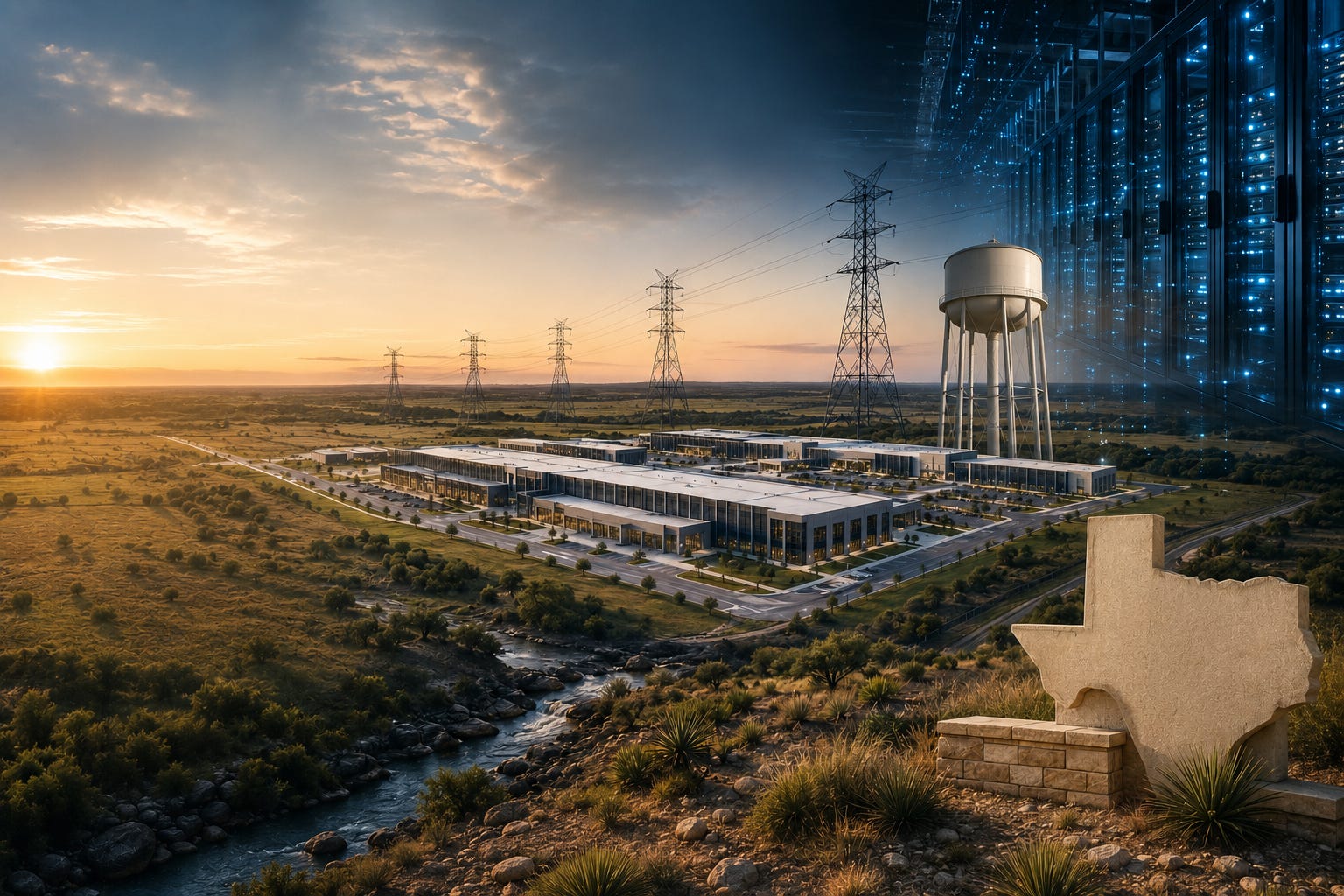
The proposed Colchis AI campus in Tom Green County offers an early glimpse into what may become one of the defining infrastructure debates of the next decade.
The project, being pursued by Cipher Digital, is envisioned as a large-scale AI and data infrastructure campus outside San Angelo. The company has attracted additional attention following a transaction involving AI infrastructure provider Fluidstack that resulted in Google acquiring an ownership interest in Cipher Digital, raising the visibility of a project that was already generating local interest.
The debate surrounding Colchis, however, is not really about artificial intelligence.
It is about infrastructure.
And increasingly, it is about water.
For years, data centers were viewed as ideal economic development projects. They generated tax revenue, required relatively few public services,
created limited traffic impacts, and rarely generated the kind of public controversy associated with refineries, manufacturing facilities, pipelines, or power plants.
Artificial intelligence is changing that equation.
The facilities being proposed today are dramatically larger than those built even a decade ago. Some campuses are expected to consume hundreds of megawatts of electricity. Others are being designed at scales approaching gigawatts.
As projects become larger, concerned communities are beginning to ask different questions:
Where will the water come from?
How much electricity will be required?
What wastewater infrastructure will be necessary?
Who pays for upgrades to local infrastructure?
What happens during drought conditions or periods of grid stress?
What benefits will local communities receive in exchange for hosting projects that may operate for decades while consuming significant local resources?
These are not anti-technology questions.
They are infrastructure questions.
And they are no longer unique to any single state.
Across the country, communities are grappling with the implications of the AI
infrastructure boom.
In Virginia, where data centers have become a defining feature of the local economy, residents and elected officials increasingly debate electricity demand, transmission expansion, land use, and community impacts.
In Arizona, concerns have emerged regarding water availability in some of the nation’s fastest-growing metropolitan areas.
In Georgia, utilities and regulators are evaluating how rapidly growing power demand from digital infrastructure could affect long-term planning decisions.
In Nevada and Utah, communities are balancing the economic benefits of new
investment against concerns regarding resource consumption and infrastructure capacity.
In California, local governments and developers have found themselves navigating increasingly complex discussions surrounding permitting, environmental review, energy demand, and local control.
Texas now appears poised to enter that same conversation. Our state’s advantages are obvious:
Affordable land.
A strong energy sector.
Growing generation capacity.
An increasingly sophisticated transmission network.
A political culture generally supportive of economic development.
Large areas of unincorporated county land where projects can move forward outside of municipal jurisdictions.
Those strengths have made Texas one of the most attractive destinations in America for AI investment.
They may also place Texas on the front lines of the policy debates that follow.
The proposed Colchis site sits outside existing municipal water and wastewater systems in an area where water resources already receive significant public attention. Publicly available information has yet to clearly identify how a project of this scale intends to secure long-term water supplies or manage wastewater generated by operations.
That does not mean solutions do not exist.
It simply means communities increasingly want to understand those solutions before construction begins.
The challenge facing policymakers is that many of today’s regulatory frameworks were built for a different era of industrial development.
County governments were not designed to evaluate gigawatt-scale computing
campuses. Groundwater districts were not built around artificial intelligence demand forecasts.
Many permitting systems were developed long before communities contemplated facilities that could rival small cities in electricity consumption.
As a result, local governments across the country are beginning to encounter a mismatch between project scale and oversight capacity.
Supporters of these projects point to billions of dollars in investment, substantial property tax revenues, construction employment, and long-term economic development opportunities.
Those benefits are real.
So are the questions being asked by residents.
Communities want transparency regarding water sourcing. Increasingly, concerned residential taxpayers are rightly voicing concern about the current or impending defilement of their own drinking water.
They want clarity regarding wastewater treatment.
They want to understand infrastructure demands before those demands materialize.
Most importantly, they want confidence that the long-term impacts on local resources have been evaluated honestly and thoroughly.
Economic development and accountability are not mutually exclusive.
Communities can welcome investment while still asking hard questions about
infrastructure planning.
Developers can pursue ambitious projects while still providing transparency regarding resource consumption.
Policymakers can encourage growth while ensuring that local governments possess the tools necessary to evaluate projects operating at an unprecedented scale.
Texas has an opportunity that many states do not.
It can prepare for these conversations before they become conflicts.
The goal is not to stop development.
Texas has rarely prospered by saying no to growth.
The goal is to ensure that growth occurs with sufficient transparency and planning to maintain public confidence in the process.
Because while the future of artificial intelligence will depend on computing power, advanced chips, and abundant energy, the pace of its expansion may ultimately be determined by something far more fundamental.
Water.
Water sustains life for all living things.
The answers developed in places like Tom Green County may ultimately shape not only the future of one project outside San Angelo, but the framework Texas and other states use to manage the largest digital infrastructure buildout in modern American history.
Priscilla Jones is a freelance business writer and strategist who has worked in conservative politics for nearly three decades. She was based in Texas until 2012 before relocating to the Washington, D.C., metro area of the data center capital of the world, Northern Virginia. She is passionate about safeguarding life-sustaining water and natural resources while honoring private property rights. In this age, transparency is essential to accomplish both.